Walk to the side of the church, to the wall that looks over Sant Josep Oriol square, and look for painted letters.
Plaça del Pi, the square of the pine
Plaça del Pi
Look for
0 of 5 foundAre you there yet?
Your position stays on your phone and is never sent anywhere.
Tap an item when you spot it.
Facts
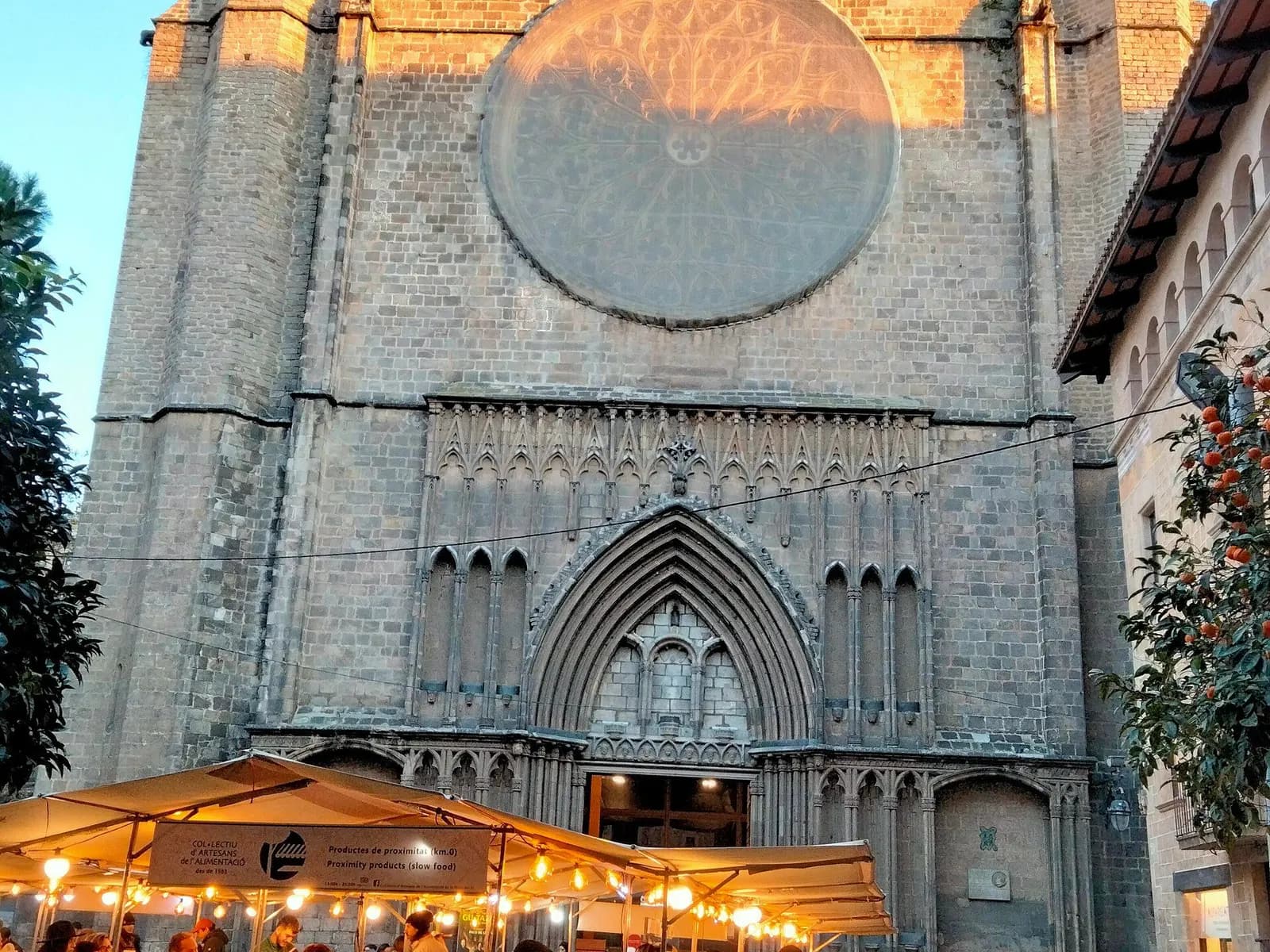
Santa Maria del Pi is Catalan Gothic, built mainly in the 14th century, with a single wide nave and chapels between the buttresses; the octagonal bell tower is 54 m tall.
Source: barcelona.cat, en.wikipedia.org, ca.wikipedia.org
Of the six bells the largest is l'Antònia, about 1.4 m across and 1,806 kg, and its ringing can be heard from many points of the Gothic Quarter. The tower was begun around 1460 under master builder Bartomeu Mas.
Source: en.wikipedia.org, barcelona.cat, ca.wikipedia.org
Above the main portal is the largest rose window in Catalonia, with twelve arms; the Gothic original was destroyed in the fire of July 1936 and the window was rebuilt from photographs and the rose windows of the monasteries of Pedralbes and Sant Cugat. Sources disagree on the year it was rebuilt.
Source: barcelona.cat, ca.wikipedia.org, en.wikipedia.org
A pine grows in the centre of the square; the present tree was planted in 1985 to replace an earlier one.
Source: ca.wikipedia.org, barcelona.cat
A church called Santa María de ipso Pino, just outside the first city walls, appears in documents of the tenth century; sources give 965 or 987.
Source: en.wikipedia.org, ca.wikipedia.org
The inscription 'Plaça del Milicià Desconegut' ('Square of the Unknown Militiaman') was painted in tar with a dry brush in early 1937 on the church's side wall; the author is unknown, probably a militiaman. The accent on the last letter of Milicià is not the correct Catalan one, and the restorers kept it.
Source: barcelona-metropolitan.com, metropoliabierta.elespanol.com, altresbarcelones.com
From 1937 to 1939 the Plaça de Sant Josep Oriol appeared on maps as the Plaça del Milicià Desconegut; when Franco's troops took the city in 1939 the inscription was covered with a wooden board. The board came off during the church restoration in 2004, the inscription was restored, and the city council added a bronze plaque dated April 2004.
Source: barcelona-metropolitan.com, barcelonalowdown.com, metropoliabierta.elespanol.com
The house of the old guild of street traders (Tenders Revenedors) stands opposite the church at the corner with Petritxol; its facade carries sgraffito that the city counts among its oldest, and the guild is said to be the oldest in Barcelona.
Source: barcelona.cat, barrigotic.cat
The Pi giants are documented from 1601 and are very probably the oldest in Catalonia; the present figures date from the 18th century, replicas were made in 1986-1987, they are called Mustafà and Elisenda, and a children's song is about them.
Source: barcelona.cat, barcelona.cat
Not yet checked on site
Legend
A fisherman found an image of the Virgin inside a pine, and a chapel built beside the tree grew into the church.
During the French occupation a Napoleonic soldier ran his bayonet through the pine and died; a new tree was planted.
Saint Josep Oriol could turn slices of radish into coins.
Told as a legend. It is a story, not a verified fact.
Visiting
- Hours
- Seen from the street · The square is open from the street at any hour; basilica interior per the basilica's own schedule
- Artists on Sant Josep Oriol: Sat 11:00-20:00, Sun 11:00-14:00.
- Food crafts fair on the square on the first and third Friday, Saturday and Sunday of each month.
- barcelona.cat lists the basilica as accessible for people with physical disabilities.
Source: barcelona.cat, barcelonalowdown.com
Good to know
- Civil War: the 1936 fire and the 1937 inscription covered up under Franco. Told factually and respectfully, without political judgement.
Photo ideas
- Classic shot
Basilica facade with the pine
Bell tower on one side, rose window centred, the pine trunk as a vertical in the foreground.
Pose: A person next to the pine for scale, facing the church.
Weekend markets block the view; early morning is clearer.
- Detail
The 'Milicià Desconegut' inscription
The whole inscription with the faint outline of the old board around it, no people in the foreground.
Pose: No posing: this is a memory marker. Photograph the inscription only.
Do not touch the wall.
- Detail
The guild house sgraffito
The house facade in close frame, showing the sgraffito pattern and the corner with Petritxol.
Pose: No pose needed; a silhouetted passer-by can give scale.
A tele lens helps crop out shop signs.