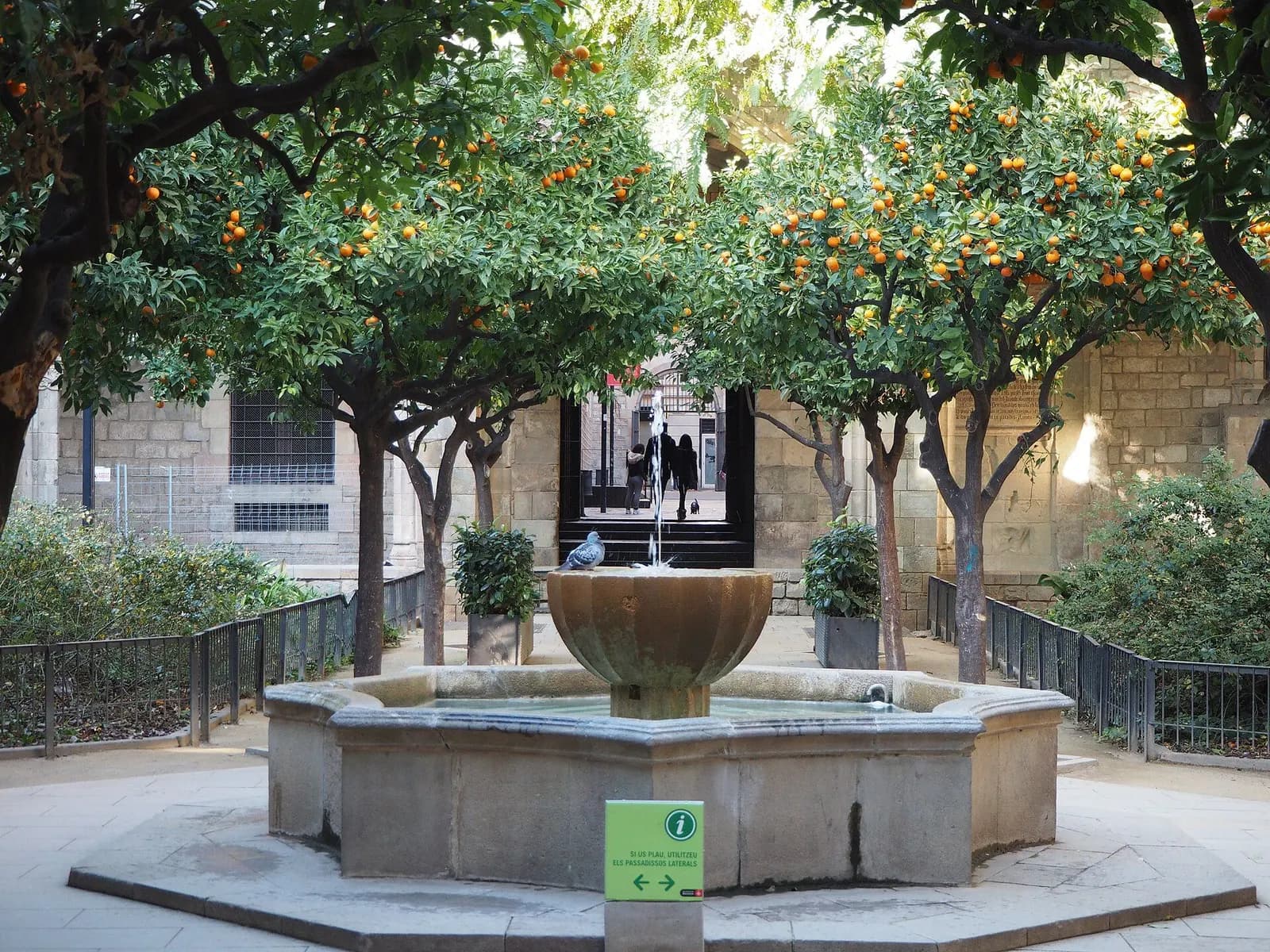
Quiet, isn't it, just a short walk from La Rambla, as if someone had switched the noise off?
The old Santa Creu hospital garden
Carrer de l'Hospital, 56
Look for
0 of 4 foundAre you there yet?
Your position stays on your phone and is never sent anywhere.
Tap an item when you spot it.
Facts
On 1 February 1401 the city council and the cathedral chapter agreed to merge six hospitals into one; the first stone was laid on 13 February with King Martin the Humane present. The hospital remained the only one in the city for five centuries.
Source: ca.wikipedia.org, en.wikipedia.org
The rib-vaulted cloister was designed by master builder Guillem Abiell in the early fifteenth century; the south wing was never built, and in 1585 two monumental staircases went up on that side, leading to the upper halls (now the access to the Library of Catalonia).
Source: ca.wikipedia.org, en.wikipedia.org
In the middle of the courtyard stands a cross on a twisted (Solomonic) column; the column and the white-and-pink marble pedestal were added by sculptor Bernat Vilar in 1691.
Source: ca.wikipedia.org, beteve.cat
The House of Convalescence (begun 1629) on the north side is now the seat of the Institute for Catalan Studies; the College of Surgeons (1764, architect Ventura Rodríguez) in front of it houses the Royal Academy of Medicine.
Source: ca.wikipedia.org, en.wikipedia.org
In 1921 the city council bought the complex. The patients moved to the new Hospital de la Santa Creu i Sant Pau in stages from 1916 to 1929, and Sant Pau officially opened in 1930. In 1931 the buildings were declared a monument of national interest, and the Library of Catalonia opened here in 1940.
Source: ca.wikipedia.org, en.wikipedia.org, desantacreuasantpau.blogspot.com, santpau.cat
Gaudí was hit by a tram on 7 June 1926 and brought to this hospital as the last patient admitted that day; he was put in the Sala dels Dolors ward and, once recognised, moved to a private room. He died on 10 June; the funeral was on 12 June, and the procession crossed the city to the Sagrada Família.
Source: desantacreuasantpau.blogspot.com, elcaso.elnacional.cat, vilaweb.cat
In the orange courtyard (pati dels tarongers) there is shade, and in spring the scent of citrus blossom; the garden in its present form is relatively recent, inside medieval walls.
Source: beteve.cat
Not yet checked on site
Legend
It is told that friends offered to move Gaudí to a private clinic and he answered 'My place is here, among the poor'. The words cannot be proven; the hospital archive only records a private room inside the hospital itself.
Told as a legend. It is a story, not a verified fact.
Visiting
- Hours
- Free entry · Daily: winter (1 Nov–31 Mar) 08:00–19:00, summer (1 Apr–31 Oct) 08:00–21:00; closing time is approximate and follows daylight. Check the official site.
- Public toilet available. Reading rooms are next door, keep voices down.
- Entrance from Carrer de l'Hospital 56 through a short passage; step-free access not confirmed.
Source: barcelona.cat, beteve.cat
Good to know
- Gaudí's death after a tram accident (1926): facts without drama; no legend in the kids version.
Photo ideas
- Classic shot
The orange courtyard with the gallery
A tree in the foreground with the gallery arches behind it.
Pose: A person walking along the gallery, back to the camera.
No flash, keep quiet.
- Detail
The cross on the twisted column
The full column against the arches and the sky.
Pose: No posing; shoot from low to high.
Do not touch the column.
- Creative
The monumental staircases
Two staircases symmetrically with Gothic windows above.
Pose: A person on the lowest step, back to the camera.
Do not climb without reason: reading rooms at the library entrance.