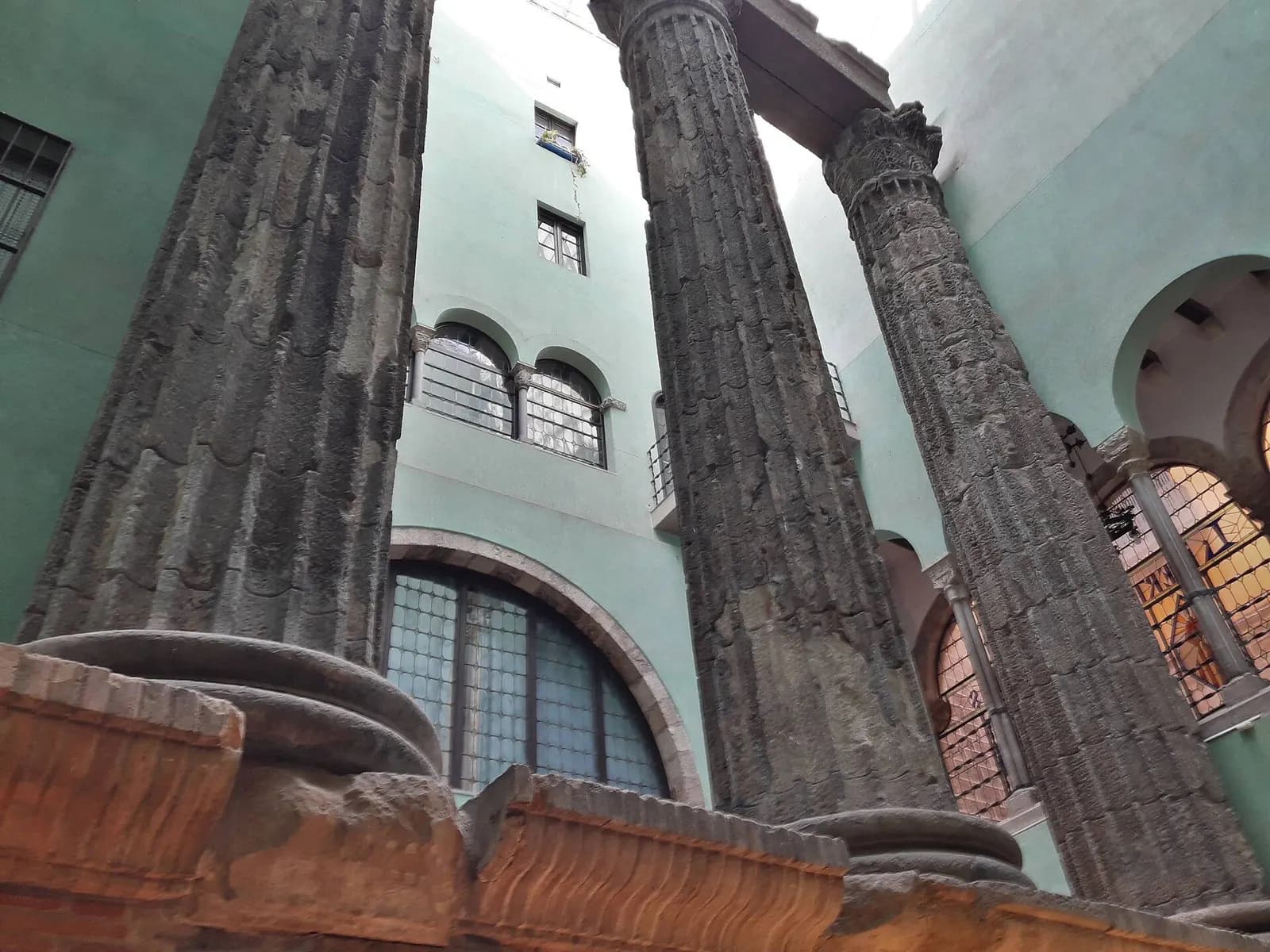
Imagine renting a flat, and finding that Roman columns are holding up your walls.
Temple of Augustus
Carrer del Paradís, 10
Look for
0 of 4 foundAre you there yet?
Your position stays on your phone and is never sent anywhere.
Tap an item when you spot it.
Facts
Four fluted columns with Corinthian capitals, part of the architrave and part of the podium survive from Barcino's temple of the imperial cult.
Source: barcelona.cat, bomaexperience.com, irbarcelona.org
The temple stood on the summit of Mont Tàber, the highest point of the colony of Barcino, as part of the forum.
Source: barcelona.cat, en.wikipedia.org
Three columns were found in the late 19th century during works on the headquarters of the Centre Excursionista de Catalunya; a fourth, kept in Plaça del Rei, was later added to the group.
Source: barcelona.cat, en.wikipedia.org
The founders of the Centre Excursionista rented a flat at Carrer del Paradís 10 and found three huge columns holding up walls and ceilings; the city had swallowed them over centuries, using them as structure. The surrounding 15th-century building is still the club's headquarters; the space belongs to the Museu d'Història de Barcelona.
Source: bomaexperience.com, irbarcelona.org
Dating of the temple varies: MUHBA now says it was 'probably begun during the reign of Tiberius' (1st century AD), earlier versions gave the 1st century BC; the dedication to Augustus is traditional but unproven. Scripts say 'about two thousand years old'.
Source: barcelona.cat, en.wikipedia.org
Josep Puig i Cadafalch reconstructed a peripteral temple (columns all around), with 11 columns along each long side counting the corner ones and 6 on the front, on a podium about a third as tall as the columns. It was declared a Cultural Asset of National Interest in 1931.
Source: en.wikipedia.org
Admission is free; hours: Mon 10:00-14:00, Tue-Sat 10:00-19:00, Sun 10:00-20:00; closed 25 Dec, 1 Jan, 1 May and 24 Jun. A visit takes about ten minutes; the nearest metro is Jaume I.
Source: barcelona.cat, bomaexperience.com, irbarcelona.org
Not yet checked on site
Visiting
- Hours
- Free entry · Mon 10:00-14:00, Tue-Sat 10:00-19:00, Sun 10:00-20:00; closed 25 Dec, 1 Jan, 1 May and 24 Jun; check the official site
- The columns are not visible from the street: enter through an ordinary doorway, then a few steps down into the courtyard (irBarcelona).
- A stone bench and information panels are nearby (irBarcelona).
Source: barcelona.cat, irbarcelona.org, bomaexperience.com
Photo ideas
- Classic shot
The four columns in the courtyard
All four columns in a row with capitals and the stretch of architrave; patient, no people.
Pose: A person beside a column for scale, back to the camera.
The courtyard is small: make room for others.
- Detail
A capital with acanthus leaves
One capital and the architrave above, leaves at frame centre.
Pose: No people: the subject on its own.
A tele lens gives detail without distortion.
- Creative
The ordinary doorway on Carrer del Paradís
The modest doorway with its plaque, a contrast with the Roman temple inside.
Pose: A person entering the doorway, back to the camera.
A plaque to the right of the entrance describes the building (irBarcelona).
That was the last stop
Back to the route to see the whole walk.
Back to my route